Testing the confidence regions and intervals 3
We consider a simple and quick-to-solve Random ODE to test the confidence regions and intervals. With a simple model, we can easily run a million simulations to test the statistics.
The Random ODE is a simple homogeneous linear equation in which the coefficient is a Wiener process and for which we know the distribution of the exact solution.
Now we consider an arbitrary number of mesh resolutions.
The equation
We consider the RODE
\[ \begin{cases} \displaystyle \frac{\mathrm{d}X_t}{\mathrm{d} t} = W_t X_t, \qquad 0 \leq t \leq T, \\ \left. X_t \right|_{t = 0} = X_0, \end{cases}\]
where $\{W_t\}_{t\geq 0}$ is a standard Wiener process. The explicit solution is
\[ X_t = e^{\int_0^t W_s \;\mathrm{d}s} X_0.\]
As seen in the first example of this documentation, once an Euler approximation is computed, along with realizations $\{W_{t_i}\}_{i=0}^n$ of a sample path of the noise, we consider an exact sample solution given by
\[ X_{t_j} = X_0 e^{\sum_{i = 0}^{j-1}\left(\frac{1}{2}\left(W_{t_i} + W_{t_{i+1}}\right)(t_{i+1} - t_i) + Z_i\right)},\]
for realizations $Z_i$ drawn from a normal distribution and scaled by the standard deviation $\sqrt{(t_{i+1} - t_i)^3/12}$. This is implemented by computing the integral recursively, via
\[ \begin{cases} I_j = I_{j-1} + \frac{1}{2}\left(W_{t_{j-1}} + W_{t_j}\right)(t_{j} - t_{j-1}) + Z_j, \\ Z_j = \sqrt{\frac{(t_{j} - t_{j-1})^3}{12}} R_j, \\ R_j \sim \mathcal{N}(0, 1), \\ \end{cases}\]
with $I_0 = 0$, and setting
\[ X_{t_j} = X_0 e^{I_j}.\]
Setting up the problem
First we load the necessary packages
using Plots
using Random
using Distributions
using RODEConvergence
Then we set up some variables, starting by choosing the Xoshiro256++ pseudo-random number generator, and setting its seed for the sake of reproducibility:
rng = Xoshiro(123)Next we set up the time interval and the initial distribution law for the initial value problem, which we take it to be a standard Distributions.Normal random variable:
t0, tf = 0.0, 1.0
x0law = Normal()
Distributions.Normal{Float64}(μ=0.0, σ=1.0)The noise is a WienerProcess starting at $y_0 = 0$:
y0 = 0.0
noise = WienerProcess(t0, tf, y0)
WienerProcess{Float64}(0.0, 1.0, 0.0)There is no parameter in the equation, so we just set params to nothing.
params = nothingThe number of mesh points for the approximations
ns = 2 .^ (5:8)4-element Vector{Int64}:
32
64
128
256The method for which we want to estimate the rate of convergence is, naturally, the Euler method, denoted RandomEuler:
method = RandomEuler()RandomEuler{Float64, Distributions.Univariate}(Float64[])We now have some choises of equations to test out.
begin ## linear homogenous with Wiener noise
    f(t, x, y, p) = y * x

    ns = 2 .^ (4:10)

    target_solver! = function (xt::Vector{T}, t0::T, tf::T, x0::T, f::F, yt::Vector{T}, params::Q, rng::AbstractRNG) where {T, F, Q}
        axes(xt) == axes(yt) || throw(
            DimensionMismatch("The vectors `xt` and `yt` must match indices")
        )

        n = size(xt, 1)
        dt = (tf - t0) / (n - 1)
        i1 = firstindex(xt)
        xt[i1] = x0
        integral = zero(T)
        zscale = sqrt(dt^3 / 12)
        for i in Iterators.drop(eachindex(xt, yt), 1)
            integral += (yt[i] + yt[i1]) * dt / 2 + zscale * randn(rng)
            xt[i] = x0 * exp(integral)
            i1 = i
        end
    end

    target = CustomUnivariateMethod(target_solver!, rng)

    ntgt = 2^12
end

begin ## linear non-homogeneous with Wiener noise
    f(t, x, y, p) = - x + y

    # The *target* solution as described above is implemented as
    target_solver! = function (xt::Vector{T}, t0::T, tf::T, x0::T, f::F, yt::Vector{T}, params::Q, rng::AbstractRNG) where {T, F, Q}
        axes(xt) == axes(yt) || throw(
            DimensionMismatch("The vectors `xt` and `yt` must match indices")
        )

        n = size(xt, 1)
        dt = (tf - t0) / (n - 1)
        i1 = firstindex(xt)
        xt[i1] = x0
        integral = zero(T)
        ti1 = zero(T)
        zscale = sqrt(dt^3 / 12)
        for i in Iterators.drop(eachindex(xt, yt), 1)
            ti = ti1 + dt
            integral += (yt[i] - yt[i1]) * (exp(ti) - exp(ti1)) / dt +  zscale * randn(rng)
            xt[i] = exp(-ti) * (x0 - integral) + yt[i]
            ti1 = ti
            i1 = i
        end
    end

    target = CustomUnivariateMethod(target_solver!, rng)

    ntgt = 2^10
end

begin ## linear homogenous with sine of Wiener noise
    f(t, x, y, p) = sin(y) * x

    noise = GeometricBrownianMotionProcess(t0, tf, 1.0, 1.0, 0.2)

    target = RandomEuler()
    ntgt = 2^16
end

begin
    f(t, x, y, p) = - sum(abs, y) * x + prod(y)

    noise = ProductProcess(
        OrnsteinUhlenbeckProcess(t0, tf, 0.2, 0.3, 0.5),
        GeometricBrownianMotionProcess(t0, tf, 0.2, 0.3, 0.5),
        CompoundPoissonProcess(t0, tf, 5.0, Exponential(0.5)),
        ExponentialHawkesProcess(t0, tf, 0.5, 0.5, 0.5, Exponential(0.5))
    )

    target = RandomEuler()
    ntgt = 2^16
end
Statistics
Now, with the helper functions, we run a loop varying the number $m$ of samples in each run and the number $nk$ of test runs, showing some relevant statistics.
m = 1
nk = 10000

nktenths = div(nk, 10)
nkfortieth = div(nk, 40)
nkhundredths = div(nk, 100)

suite = ConvergenceSuite(t0, tf, x0law, f, noise, params, target, method, ntgt, ns, m)

deltas = (suite.tf - suite.t0) ./ suite.ns

@time allerrors = mapreduce(i -> solve(rng, suite).errors', vcat, 1:nk)
10000×7 Matrix{Float64}:
0.034588 0.0332348 0.0148731 … 0.00167533 0.000906995
0.00350366 0.00195087 0.000721746 0.000108405 6.06482e-5
0.0233795 0.0111936 0.00715596 0.000825212 0.000291453
0.0272287 0.00933148 0.00594742 0.00106511 0.00043214
0.00307598 0.00180301 0.000921039 0.000118992 6.94217e-5
0.00820463 0.00400803 0.00202483 … 0.000342559 0.000107584
0.0022233 0.00143584 0.000608864 0.000131602 6.11307e-5
0.0243874 0.0119086 0.00889488 0.00127886 0.000426953
0.0323656 0.0183606 0.00900697 0.000602713 0.000385757
0.00381985 0.00142289 0.00139676 0.000203599 5.33787e-5
⋮ ⋱ ⋮
0.0426571 0.0177881 0.00387094 0.000803199 0.000810363
0.0122743 0.00407009 0.0022611 0.000495511 0.000126227
0.0144092 0.013967 0.00927954 0.000492989 0.000227238
0.0156585 0.0202177 0.0081986 0.000771954 0.000406595
0.00363168 0.00192584 0.000870993 … 0.000111173 6.31862e-5
0.0216847 0.0223077 0.0071473 0.000637114 0.000606374
0.00940982 0.00743633 0.00658847 0.000379586 0.000100533
0.0320884 0.0164777 0.0105353 0.000994605 0.000717784
0.0548989 0.015056 0.0147024 0.00216307 0.000896211logallerrors = log.(allerrors)
allmeans = mean(allerrors, dims=1)1×7 Matrix{Float64}:
0.0220961 0.0114369 0.00585344 0.00296678 … 0.000750733 0.000373083means_num = 100
@assert mod(nk, means_num) == 0
means_size = div(nk, means_num)
@assert means_num * means_size == nk
partialmeans = mapreduce(n -> mean(allerrors[n+1:n+1+means_size, :], dims=1), vcat, 0:means_num-1)
meansofmeans = mean(partialmeans, dims=1)
stdmeans = std(partialmeans, dims=1)1×7 Matrix{Float64}:
0.00157856 0.000802647 0.000499506 … 3.55732e-5 1.96984e-5 8.57439e-6plt = begin
plot(title="Pathwise and mean errors", titlefont=12, xscale=:log10, yscale=:log10, xlabel="\$\\Delta t\$", ylabel="\$\\textrm{error}\$", legend=:topleft, xlims=(last(deltas)/2, 2first(deltas)))
scatter!(deltas, allerrors[1, :], color=:gray, alpha=0.1, label="pathwise errors ($nktenths samples)")
scatter!(deltas, allerrors[2:nktenths, :]', label=false, color=:gray, alpha=0.01)
scatter!(deltas, mean(allerrors[1:nkhundredths, :], dims=1)', label="mean errors ($nkhundredths samples)", color=1, alpha=0.8)
scatter!(deltas, mean(allerrors[1:nkfortieth, :], dims=1)', label="mean errors ($nkfortieth samples)", color=2, alpha=0.8)
scatter!(deltas, allmeans', label="mean errors ($nk samples)", color=3, alpha=0.8)
end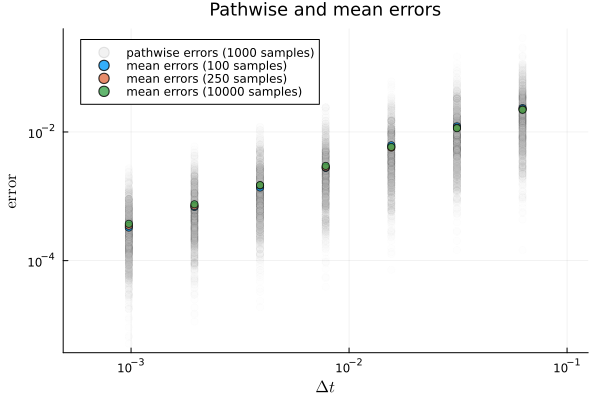
plt = begin
    plts = Any[]
    for ncol in axes(allerrors, 2)
        pltcol = plot(title="Histogram of pathwise errors for \$\\delta= 2^{$(ns[ncol])}\$", titlefont=8)
        histogram!(pltcol, allerrors[1:nktenths, ncol], label="$nktenths samples")
        histogram!(pltcol, allerrors[1:nkfortieth, ncol], label="$nkfortieth samples")
        histogram!(pltcol, allerrors[1:nkhundredths, ncol], label="$nkhundredths samples")
        push!(plts, pltcol)
    end
    plot(size=(800, 300*div(length(ns), 2)), plts...)
end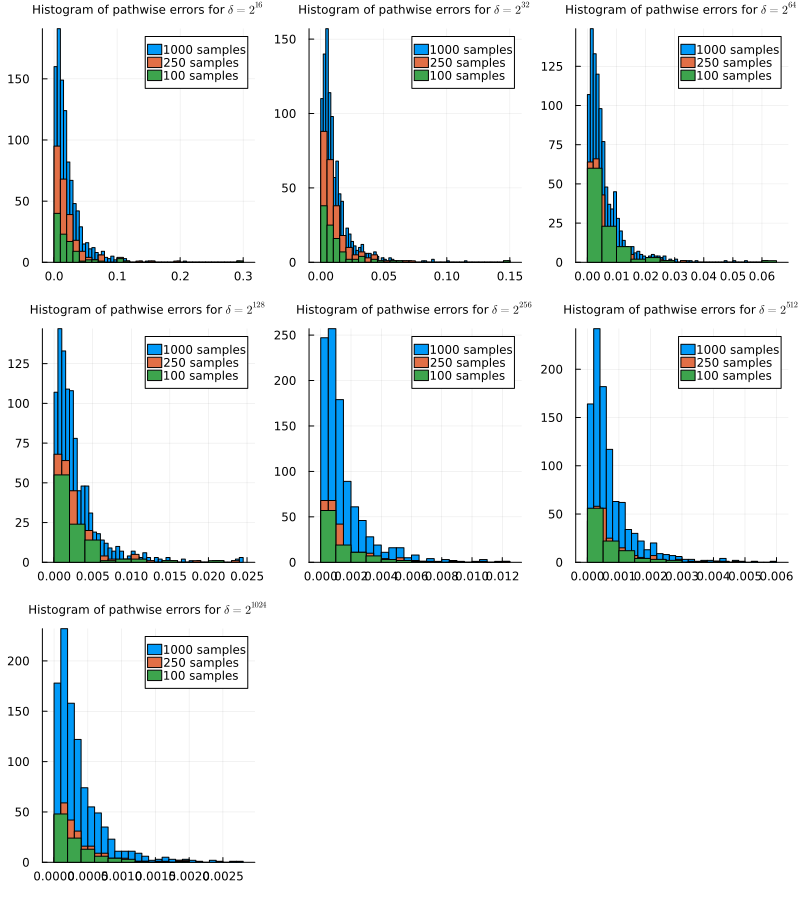
plt = begin
    plts = Any[]
    for ncol in axes(allerrors, 2)
        pltcol = plot(title="Histogram of log of pathwise errors for \$\\delta= 2^{$(ns[ncol])}\$", titlefont=8, legend=:topleft)
        histogram!(pltcol, logallerrors[1:nktenths, ncol], label="$nktenths samples")
        histogram!(pltcol, logallerrors[1:nkfortieth, ncol], label="$nkfortieth samples")
        histogram!(pltcol, logallerrors[1:nkhundredths, ncol], label="$nkhundredths samples")
        push!(plts, pltcol)
    end
    plot(size=(800, 300*div(length(ns), 2)), plts...)
end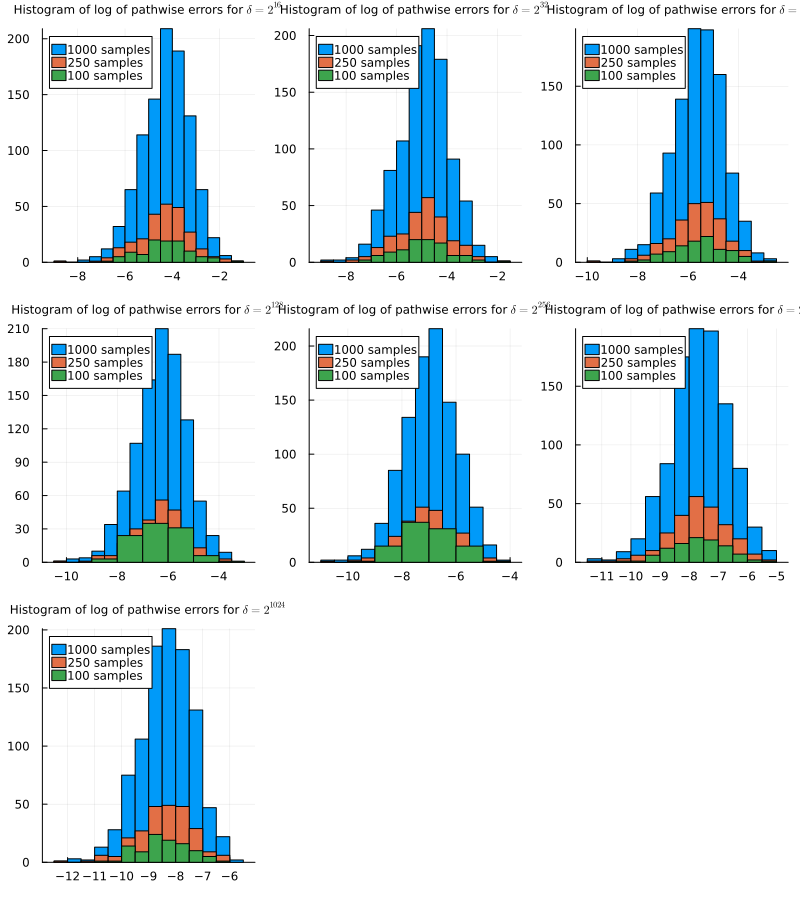
plt = begin
    plts = Any[]
    for ncol in axes(allerrors, 2)
        fitteddists = [
            (dist, fit(dist, logallerrors[:, ncol]) ) for dist in (Normal, Cauchy)
        ]
        pltcol = plot(title="Histogram and fit of log of pathwise errors for \$\\delta= 2^{$(ns[ncol])}\$", titlefont=8, legend=:topleft)
        histogram!(pltcol, logallerrors[1:nktenths, ncol], normalize=:pdf, label="$nktenths samples")
        for fitteddist in fitteddists
            plot!(pltcol, x -> pdf(fitteddist[2], x), label="fitted $(fitteddist[1])")
        end
        plot!(pltcol, x -> pdf(Logistic(mean(logallerrors[:, ncol]), √3*var(logallerrors[:, ncol])/π), x), label="adjusted Logistic")
        push!(plts, pltcol)
    end
    plot(size=(800, 300*div(length(ns), 2)), plts...)
end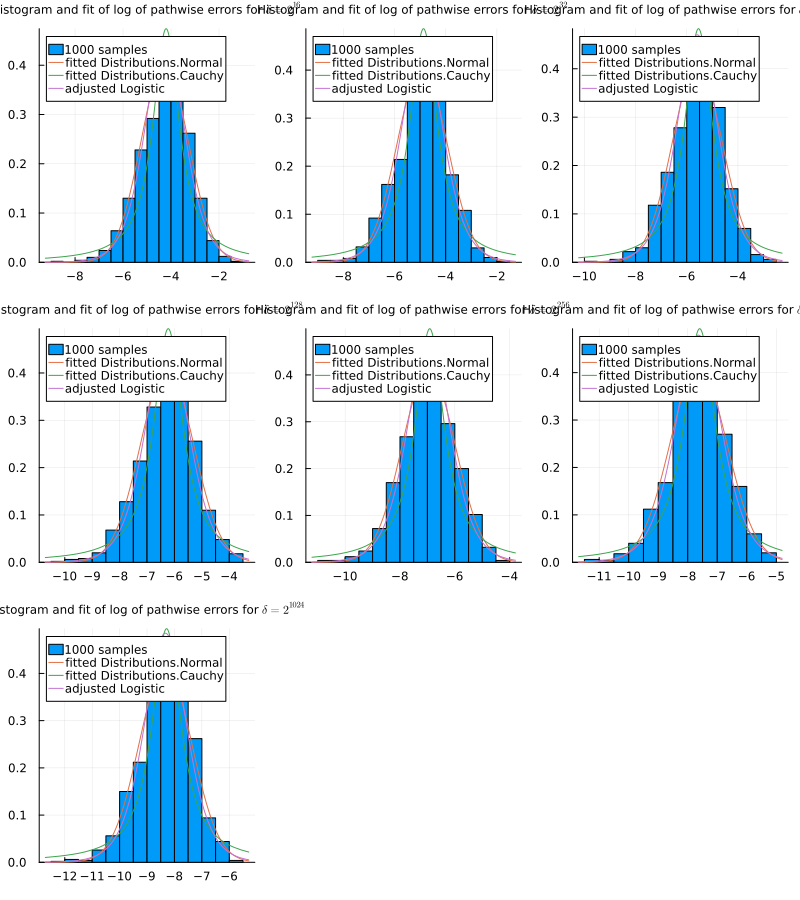
plt = begin
    plts = Any[]
    for ncol in axes(allerrors, 2)
        fittedlognormal = fit(LogNormal, allerrors[:, ncol])
        fittedexponential = fit(Exponential, allerrors[:, ncol])
        pltcol = plot(title="Histogram and fit of log of pathwise errors for \$\\delta= 2^{$(ns[ncol])}\$", titlefont=8, legend=:topleft, xlims=(0.0, mean(allerrors[:, ncol]) + 2std(allerrors[:, ncol])))
        histogram!(pltcol, allerrors[1:nktenths, ncol], normalize=:pdf, label="$nktenths samples")
        plot!(pltcol, x -> pdf(fittedlognormal, x), label="fitted logNormal")
        plot!(pltcol, x -> pdf(fittedexponential, x), label="fitted Exponential")
        push!(plts, pltcol)
    end
    plot(size=(800, 300*div(length(ns), 2)), plts..., legend=:topright)
end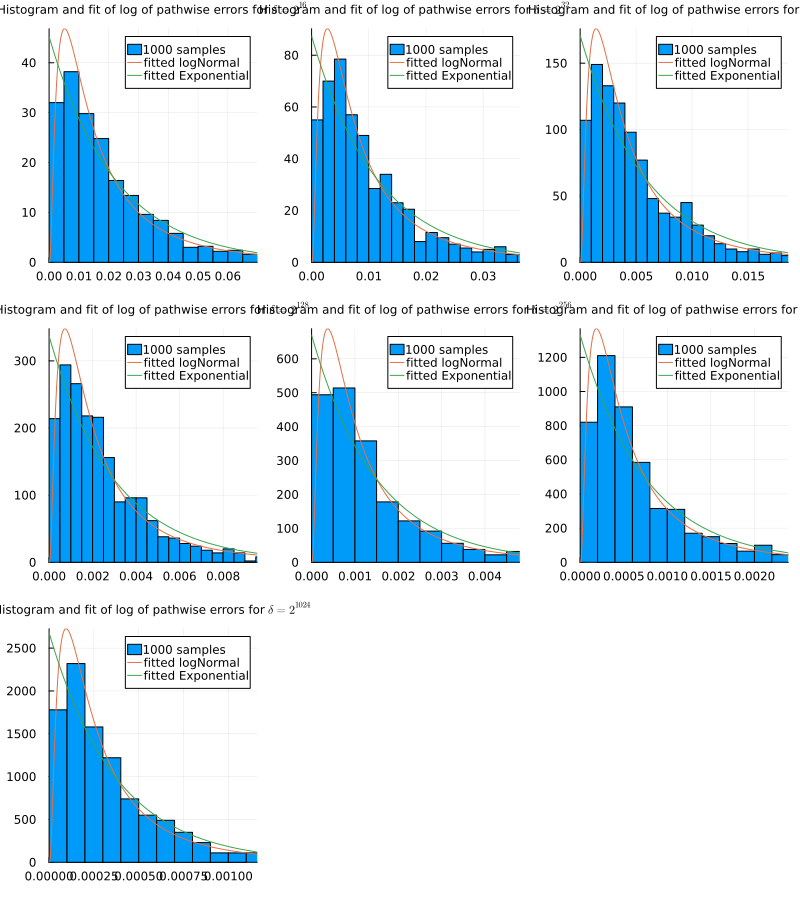
plt = begin
    plts = Any[]
    for ncol in axes(allerrors, 2)
        pltcol = plot(title="Histogram of  error means for \$\\delta= 2^{$(ns[ncol])}\$", titlefont=8)
        histogram!(pltcol, partialmeans[:, ncol], nbins = 40, label="$means_num means from $means_size samples")
        push!(plts, pltcol)
    end
    plot(size=(800, 300*div(length(ns), 2)), plts...)
end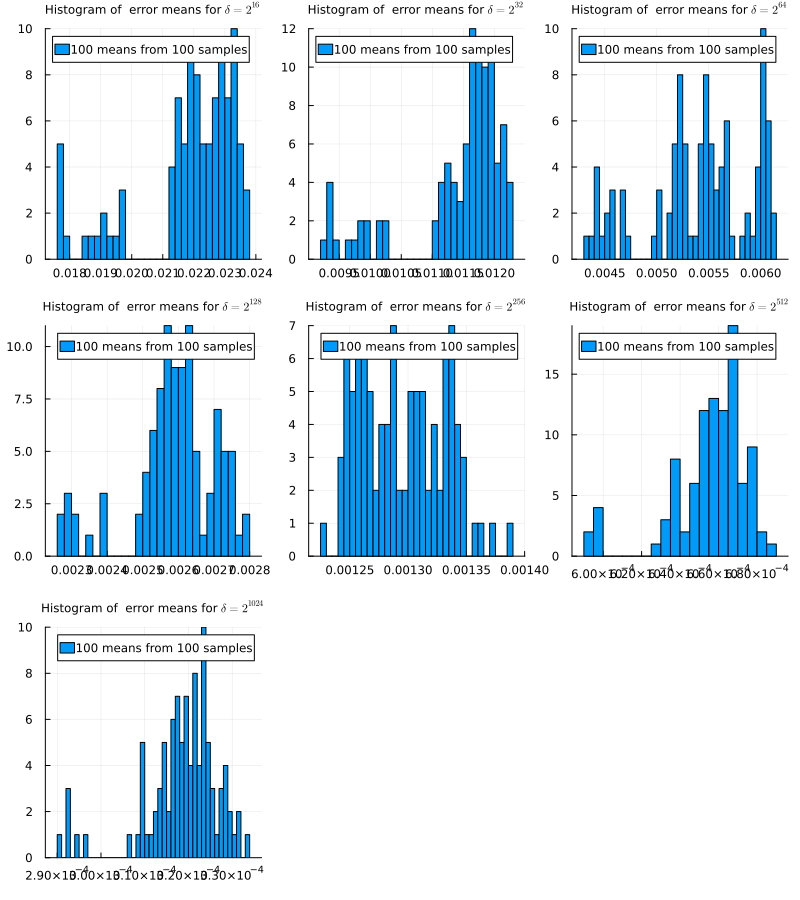
plt = begin
    plot(log.(deltas), log.(allerrors[1:100, :]'), alpha=0.5, legend=false)
    plot!(log.(deltas), l -> l + 1, color=:black, linewidth=2)
    plot!(log.(deltas), l -> l - 1.5, color=:black, linewidth=2)
    plot!(log.(deltas), l -> l - 4, color=:black, linewidth=2)
    plot!(log.(deltas), l -> l/2 - 10, color=:red, alpha=0.5, linewidth=2)
    plot!(log.(deltas), l -> 2l - 1, color=:blue, alpha=0.5, linewidth=2)
end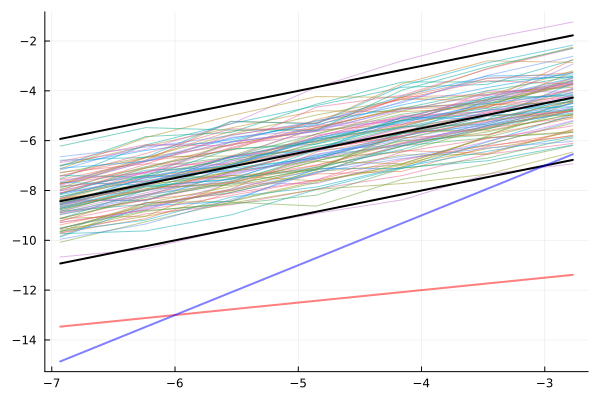
A = [one.(deltas) log.(deltas)]
L = inv(A' * A) * A'
lCps = reduce(hcat, [L * log.(allerrors[n, :]) for n in axes(allerrors, 1)])

extrema(lCps[2, :])
pmeans = mean(lCps[2, :])
Nps = fit(Normal, lCps[2, :])

plt = begin
    plot(title="Order of convergence of individual path samples")
    histogram(lCps[2, :], label="\$p(\\omega)\$", normalize=:pdf)
    vline!([pmeans], linewidth=2, label="\$\\mathbb{E}[p] = $(round(pmeans, digits=2))\$")
    plot!(p -> pdf(Nps, p), label="fitted \$\\mathcal{N}($(round(Nps.μ, digits=2)), $(round(Nps.σ, digits=2))^2)\$")
end

pbounds = [minimum( ( log.(allerrors[n, :]) .- maximum(lCps[1, :]) ) ./ log.(deltas) ) for n in axes(allerrors, 1)]

plt = begin
    plot(title="Not right quantity to look at")
    histogram(pbounds)
end


pboundsev = [minimum( ( log.(allerrors[n, 1:k]) .- maximum(lCps[1, 1:k]) ) ./ log.(deltas[1:k]) ) for n in axes(allerrors, 1), k in 2:7]

begin
    histogram(pboundsev[:, 1], alpha=0.1)
    histogram!(pboundsev[:, 2], alpha=0.1)
    histogram!(pboundsev[:, 3], alpha=0.1)
    histogram!(pboundsev[:, 4], alpha=0.1)
    histogram!(pboundsev[:, 5], alpha=0.1)
    histogram!(pboundsev[:, 5], alpha=0.1)
end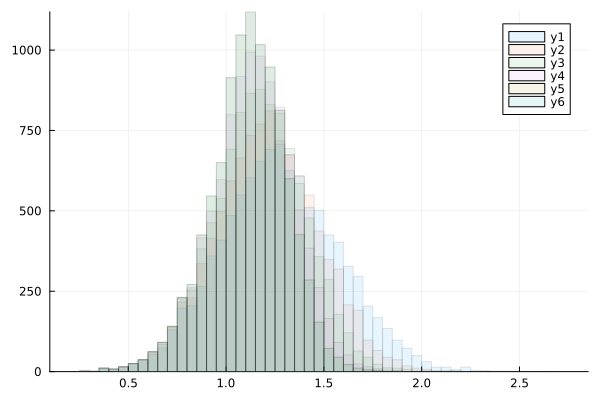
nothingThis page was generated using Literate.jl.