Testing the confidence regions and intervals 1
We consider a simple and quick-to-solve Random ODE to test the confidence regions and intervals. With a simple model, we can easily run a million simulations to test the statistics.
The Random ODE is a simple homogeneous linear equation in which the coefficient is a Wiener process and for which we know the distribution of the exact solution.
In this first example, we consider only two mesh resolutions, for full visualization.
The equation
We consider the RODE
\[ \begin{cases} \displaystyle \frac{\mathrm{d}X_t}{\mathrm{d} t} = W_t X_t, \qquad 0 \leq t \leq T, \\ \left. X_t \right|_{t = 0} = X_0, \end{cases}\]
where $\{W_t\}_{t\geq 0}$ is a standard Wiener process. The explicit solution is
\[ X_t = e^{\int_0^t W_s \;\mathrm{d}s} X_0.\]
As seen in the first example of this documentation, once an Euler approximation is computed, along with realizations $\{W_{t_i}\}_{i=0}^n$ of a sample path of the noise, we consider an exact sample solution given by
\[ X_{t_j} = X_0 e^{\sum_{i = 0}^{j-1}\left(\frac{1}{2}\left(W_{t_i} + W_{t_{i+1}}\right)(t_{i+1} - t_i) + Z_i\right)},\]
for realizations $Z_i$ drawn from a normal distribution and scaled by the standard deviation $\sqrt{(t_{i+1} - t_i)^3/12}$. This is implemented by computing the integral recursively, via
\[ \begin{cases} I_j = I_{j-1} + \frac{1}{2}\left(W_{t_{j-1}} + W_{t_j}\right)(t_{j} - t_{j-1}) + Z_j, \\ Z_j = \sqrt{\frac{(t_{j} - t_{j-1})^3}{12}} R_j, \\ R_j \sim \mathcal{N}(0, 1), \\ \end{cases}\]
with $I_0 = 0$, and setting
\[ X_{t_j} = X_0 e^{I_j}.\]
Setting up the problem
First we load the necessary packages
using Plots
using Random
using Distributions
using RODEConvergence
Then we set up some variables, starting by choosing the Xoshiro256++ pseudo-random number generator, and setting its seed for the sake of reproducibility:
rng = Xoshiro(123)We set the right hand side of the equation:
f(t, x, y, p) = y * xNext we set up the time interval and the initial distribution law for the initial value problem, which we take it to be a standard Distributions.Normal random variable:
t0, tf = 0.0, 1.0
x0law = Normal()
Distributions.Normal{Float64}(μ=0.0, σ=1.0)The noise is a WienerProcess starting at $y_0 = 0$:
y0 = 0.0
noise = WienerProcess(t0, tf, y0)
WienerProcess{Float64}(0.0, 1.0, 0.0)There is no parameter in the equation, so we just set params to nothing.
params = nothingThe number of mesh points for the target solution and the approximations
ntgt = 2^8
ns = 2 .^ (4:2:6)
2-element Vector{Int64}:
16
64Notice we just chose two mesh sizes, so we can easily visualize the distributions.
The target solution as described above is implemented as
target_solver! = function (xt::Vector{T}, t0::T, tf::T, x0::T, f::F, yt::Vector{T}, params::Q, rng::AbstractRNG) where {T, F, Q}
    axes(xt) == axes(yt) || throw(
        DimensionMismatch("The vectors `xt` and `yt` must match indices")
    )

    n = size(xt, 1)
    dt = (tf - t0) / (n - 1)
    i1 = firstindex(xt)
    xt[i1] = x0
    integral = zero(T)
    zscale = sqrt(dt^3 / 12)
    for i in Iterators.drop(eachindex(xt, yt), 1)
        integral += (yt[i] + yt[i1]) * dt / 2 + zscale * randn(rng)
        xt[i] = x0 * exp(integral)
        i1 = i
    end
end
and with that we construct the CustomMethod that solves the problem with this target_solver!:
target = CustomUnivariateMethod(target_solver!, rng)The method for which we want to estimate the rate of convergence is, naturally, the Euler method, denoted RandomEuler:
method = RandomEuler()RandomEuler{Float64, Distributions.Univariate}(Float64[])Defining helper functions
We first write some helper functions to grab the statistics, print some information, and build some plots.
function getstatistics(rng, suite, ns, nk, m)
    ps = zeros(nk)
    pmins = zeros(nk)
    pmaxs = zeros(nk)
    allerrors = zeros(nk, length(ns))
    allstderrs = zeros(nk, length(ns))
    @time for k in 1:nk
        resultk = solve(rng, suite)
        ps[k] = resultk.p
        allerrors[k, :] .= resultk.errors
        allstderrs[k, :] .= resultk.stderrs
        pmins[k] = resultk.pmin
        pmaxs[k] = resultk.pmax
    end
    meanerror = mean(allerrors, dims=1)
    pmean = mean(ps)

    percent_e1_in = 100 * count(( meanerror[1] .> allerrors[:, 1] .- 1.96allstderrs[:, 1] ) .& ( meanerror[1] .< allerrors[:, 1] .+ 1.96allstderrs[:, 1] )) / nk

    percent_e2_in = 100 * count(( meanerror[2] .> allerrors[:, 2] .- 1.96allstderrs[:, 2] ) .& ( meanerror[2] .< allerrors[:, 2] .+ 1.96allstderrs[:, 2] )) / nk

    percent_e_in = 100 * count(
        ( meanerror[1] .> allerrors[:, 1] .- 2.24allstderrs[:, 1] ) .& ( meanerror[1] .< allerrors[:, 1] .+ 2.24allstderrs[:, 1] ) .&
        ( meanerror[2] .> allerrors[:, 2] .- 2.24allstderrs[:, 2] ) .& ( meanerror[2] .< allerrors[:, 2] .+ 2.24allstderrs[:, 2] )
        ) / nk

    percent_ehalf_in = 100 * count(
        ( meanerror[1] .> allerrors[1:div(nk,2), 1] .- 2.24allstderrs[1:div(nk,2), 1] ) .& ( meanerror[1] .< allerrors[1:div(nk,2), 1] .+ 2.24allstderrs[1:div(nk,2), 1] ) .&
        ( meanerror[2] .> allerrors[div(nk,2)+1:nk, 2] .- 2.24allstderrs[div(nk,2)+1:nk, 2] ) .& ( meanerror[2] .< allerrors[div(nk,2)+1:nk, 2] .+ 2.24allstderrs[div(nk,2)+1:nk, 2] )
        ) / nk * 2

    percent_edealigned_in = 100 * count(
        ( meanerror[1] .> allerrors[begin:end-1, 1] .- 2.24allstderrs[begin:end-1, 1] ) .& ( meanerror[1] .< allerrors[begin:end-1, 1] .+ 2.24allstderrs[begin:end-1, 1] ) .&
        ( meanerror[2] .> allerrors[begin+1:end, 2] .- 2.24allstderrs[begin+1:end, 2] ) .& ( meanerror[2] .< allerrors[begin+1:end, 2] .+ 2.24allstderrs[begin+1:end, 2] )
        ) / ( nk - 1 )

    deltas = (suite.tf - suite.t0) ./ suite.ns
    A = [one.(deltas) log.(deltas)]
    L = inv(A' * A) * A'

    Llnerrors = L * log.(allerrors')

    Llnerrorsdealigned = L * log.([allerrors[:, 1] circshift(allerrors[:, 2], -1)]')

    percent_p_dealigned_in = 100 * count( ( pmean .> Llnerrorsdealigned[2, :] .- (ps .- pmins) ) .& ( pmean .< Llnerrorsdealigned[2, :] .+ (pmaxs .- ps) ) ) / nk

    percent_p_in = 100 * count(( pmean .> pmins ) .& ( pmean .< pmaxs )) / nk

    pstd = std(ps)
    percent_p_alt_in = 100 * count(( pmean .> ps .- 1.96pstd ) .& ( pmean .< ps .+ 1.96pstd )) / nk

    pdlgnstd = std(Llnerrorsdealigned[2, :])
    percent_p_alt_dealigned_in = 100 * count(( pmean .> Llnerrorsdealigned[2, :] .- 1.96pdlgnstd ) .& ( pmean .< Llnerrorsdealigned[2, :] .+ 1.96pdlgnstd )) / nk

    return ps, allerrors, allstderrs, meanerror, pmean, Llnerrors, Llnerrorsdealigned, percent_p_in, percent_p_dealigned_in, percent_p_alt_dealigned_in, percent_e1_in, percent_e2_in, percent_e_in, percent_ehalf_in, percent_edealigned_in, L
end

function printpercents(
    percent_p_in, percent_p_dealigned_in, percent_p_alt_dealigned_in, percent_e1_in, percent_e2_in, percent_e_in, percent_ehalf_in, percent_edealigned_in
)
    println("percent p in: $percent_p_in%")
    println("percent p dealigned in: $percent_p_dealigned_in%")
    println("percent p alt dealigned in: $percent_p_alt_dealigned_in%")
    println("percent E1 in: $percent_e1_in%")
    println("percent E2 in: $percent_e2_in%")
    println("percent E in: $percent_e_in%")
    println("percent E in half-half: $percent_ehalf_in%")
    println("percent E in dealigned larger: $percent_edealigned_in%")
end

function showplots(
    ps, allerrors, Llnerrors, Llnerrorsdealigned, pmean, result, m, nk, percent_e1_in, percent_e2_in, percent_e_in, percent_ehalf_in, percent_p_dealigned_in, percent_edealigned_in, L
)
    rect = Shape(
        [
            (result.errors[1] - 2.24result.stderrs[1], result.errors[2] - 2.24result.stderrs[2]),
            (result.errors[1] - 2.24result.stderrs[1], result.errors[2] + 2.24result.stderrs[2]),
            (result.errors[1] + 2.24result.stderrs[1], result.errors[2] + 2.24result.stderrs[2]),
            (result.errors[1] + 2.24result.stderrs[1], result.errors[2] - 2.24result.stderrs[2])
        ]
    )

    plt_errors = plot(title="Errors all (m=$m, nk=$nk)", titlefont=10, xlabel="ϵ₁", ylabel="ϵ₂")

    scatter!(plt_errors, allerrors[:, 1], allerrors[:, 2], alpha=0.2, label="errors ($(round(percent_e_in, digits=2))% in CI)")
    scatter!(plt_errors, allerrors[begin:end-1, 1], allerrors[begin+1:end, 2], alpha=0.2, label="errors dealigned ($(round(percent_edealigned_in, digits=2))% in CI)")
    scatter!(plt_errors, Tuple(mean(allerrors, dims=1)), markersize=4, label="error mean")
    plot!(plt_errors, rect, alpha=0.2, label="CI")

    plt_errors_split = plot(title="Errors split (m=$m, nk=$nk) \n ($(round(percent_ehalf_in, digits=2))% in CI)", titlefont=10, xlabel="ϵ₁", ylabel="ϵ₂")
    begin
        scatter!(plt_errors_split, allerrors[1:div(nk,2), 1], allerrors[div(nk,2)+1:nk, 2], alpha=0.2, label="errors")
        scatter!(plt_errors_split, Tuple(mean(allerrors, dims=1)), markersize=4, label="error mean")
        plot!(plt_errors_split, rect, alpha=0.2, label="CI")
    end

    plt_errors_dealigned = plot(title="Errors dealigned (m=$m, nk=$nk) \n ($(round(percent_edealigned_in, digits=2))% in CI)", titlefont=10, xlabel="ϵ₁", ylabel="ϵ₂")
    begin
        scatter!(plt_errors_dealigned, allerrors[begin:end-1, 1], allerrors[begin+1:end, 2], alpha=0.2, label="errors")
        scatter!(plt_errors_dealigned, Tuple(mean(allerrors, dims=1)), markersize=4, label="error mean")
        plot!(plt_errors_dealigned, rect, alpha=0.2, label="CI")
    end

    plt_hist_e1 = plot(title="Histogram of ϵ₁ (m=$m, nk=$nk) \n ($(round(percent_e1_in, digits=2))% in CI)", titlefont=10, xlabel="ϵ₁")
    begin
        histogram!(plt_hist_e1, allerrors[:, 1], label="error ϵ₁")
        vline!(plt_hist_e1, [mean(allerrors[:, 1])], color=:steelblue, linewidth=4, label="mean")
        vline!(plt_hist_e1, [result.errors[1]], label="sample")
        vline!(plt_hist_e1, [result.errors[1] - 2result.stderrs[1], result.errors[1] + 2result.stderrs[1]], label="CI from sample")
    end

    plt_hist_e2 = plot(title="Histogram of ϵ₂ (m=$m, nk=$nk) \n ($(round(percent_e2_in, digits=2))% in CI)", titlefont=10, xlabel="ϵ₂")
    begin
        histogram!(plt_hist_e2, allerrors[:, 2], label="error ϵ₂")
        vline!(plt_hist_e2, [mean(allerrors[:, 2])], color=:steelblue, linewidth=4, label="mean")
        vline!(plt_hist_e2, [result.errors[2]], label="sample")
        vline!(plt_hist_e2, [result.errors[2] - 2result.stderrs[2], result.errors[2] + 2result.stderrs[2]], label="CI from sample")
    end

    sn = 50
    s1 = L * log.(max.(0.0, [result.errors[1] .+ 2.24result.stderrs[1] * range(-1, 1, length=sn) ( result.errors[2] - 2.24result.stderrs[2] ) .* ones(sn)]'))
    s2 = L * log.(max.(0.0, [( result.errors[1] + 2.24result.stderrs[1] ) .* ones(sn) result.errors[2] .+ 2.24result.stderrs[2] * range(-1, 1, length=sn)]'))
    s3 = L * log.(max.(0.0, [result.errors[1] .+ 2.24result.stderrs[1] * reverse(range(-1, 1, length=sn)) ( result.errors[2] + 2.24result.stderrs[2] ) .* ones(sn)]'))
    s4 = L * log.(max.(0.0, [( result.errors[1] - 2.24result.stderrs[1] ) .* ones(sn) result.errors[2] .+ 2.24result.stderrs[2] * range(-1, 1, length=sn)]'))
    sides = hcat(s1, s2, s3, s4)

    temean = L * log.(mean(allerrors, dims=1)')

    plt_Cp = plot(title="(C, p) sample from (ϵ₁, ϵ₂) (m=$m, nk=$nk)", titlefont=10, xlabel="C", ylabel="p")
    begin
        scatter!(plt_Cp, Llnerrors[1, :], Llnerrors[2, :], alpha=0.2, label="correlated")
        scatter!(plt_Cp, Llnerrorsdealigned[1, :], Llnerrorsdealigned[2, :], alpha=0.2, label="dealigned")
        plot!(plt_Cp, sides[1, :], sides[2, :], label="transformed errors CI")
        scatter!(plt_Cp, Tuple(temean), markersize=4, color=:orange, label="transformed error mean")
        hline!(plt_Cp, [pmean], label="p mean")
        hline!(plt_Cp, [result.pmin, result.pmax], label="sample p CI ($(round(percent_p_dealigned_in, digits=2))% in CI)")
        hline!(plt_Cp, [result.p], label="sample p")
    end

    plt_hist_p = plot(title="Histogram of p (m=$m, nk=$nk) \n ($(round(percent_p_dealigned_in, digits=2))% in CI)", titlefont=10, xlabel="ϵ₁")
    begin
        histogram!(plt_hist_p, Llnerrorsdealigned[2, :], label="p dealigned")
        histogram!(plt_hist_p, ps, label="p")
        vline!(plt_hist_p, [pmean], linewidth=4, label="p mean")
        vline!(plt_hist_p, [result.pmin, result.pmax], label="sample p CI ($(round(percent_p_dealigned_in, digits=2))% in CI)")
        vline!(plt_hist_p, [result.p], label="sample p")
    end

    plts = (
        errors = plt_errors,
        split = plt_errors_split,
        dealigned = plt_errors_dealigned,
        hist1 = plt_hist_e1,
        hist2 = plt_hist_e2,
        cp = plt_Cp,
        histp = plt_hist_p
    )

    return plts
end
showplots (generic function with 1 method)Statistics
Now, with the helper functions, we run a loop varying the number $m$ of samples in each run and the number $nk$ of test runs, showing some relevant statistics.
ms = (200, 500, 1000, 2000)
nks = (2000, 2000, 2000, 2000)

@assert all(iseven, nks)

allplts = Any[]

for (nrun, m, nk) in zip(eachindex(ms), ms, nks)

    @info "==="
    @info "Run $nrun with m=$m and nk=$nk"
    suite = ConvergenceSuite(t0, tf, x0law, f, noise, params, target, method, ntgt, ns, m)

    ps, allerrors, allstderrs, meanerror, pmean, Llnerrors, Llnerrorsdealigned, percent_p_in, percent_p_dealigned_in, percent_p_alt_dealigned_in, percent_e1_in, percent_e2_in, percent_e_in, percent_ehalf_in, percent_edealigned_in, L = getstatistics(rng, suite, ns, nk, m)

    @show cor(allerrors) # strongly correlated!

    @show cor([allerrors[:, 1] circshift(allerrors[:, 2], -1)]) # weakly correlated

    @show cor(Llnerrors') # somehow correlated

    @show cor(Llnerrorsdealigned') # weakly correlated

    printpercents(percent_p_in, percent_p_dealigned_in, percent_p_alt_dealigned_in, percent_e1_in, percent_e2_in, percent_e_in, percent_ehalf_in, percent_edealigned_in)

    result = solve(rng, suite)

    plts = showplots(ps, allerrors, Llnerrors, Llnerrorsdealigned, pmean, result, m, nk, percent_e1_in, percent_e2_in, percent_e_in, percent_ehalf_in, percent_p_dealigned_in, percent_edealigned_in, L)

    append!(allplts, [plts])
end
[ Info: ===
[ Info: Run 1 with m=200 and nk=2000
1.790115 seconds (559.73 k allocations: 35.576 MiB, 5.16% compilation time)
cor(allerrors) = [1.0 0.9665001967310431; 0.9665001967310431 1.0]
cor([allerrors[:, 1] circshift(allerrors[:, 2], -1)]) = [1.0 0.004366792807638015; 0.004366792807638015 1.0]
cor(Llnerrors') = [1.0 0.4685970909054743; 0.4685970909054743 1.0]
cor(Llnerrorsdealigned') = [1.0 0.9801612432754556; 0.9801612432754556 1.0]
percent p in: 100.0%
percent p dealigned in: 99.0%
percent p alt dealigned in: 94.55%
percent E1 in: 90.8%
percent E2 in: 89.9%
percent E in: 91.05%
percent E in half-half: 86.4%
percent E in dealigned larger: 85.49274637318659%
[ Info: ===
[ Info: Run 2 with m=500 and nk=2000
4.265574 seconds (178.00 k allocations: 15.839 MiB)
cor(allerrors) = [1.0 0.9679473287501448; 0.9679473287501448 1.0]
cor([allerrors[:, 1] circshift(allerrors[:, 2], -1)]) = [1.0 0.006279476014600148; 0.006279476014600148 1.0]
cor(Llnerrors') = [1.0 0.4181673539848899; 0.4181673539848899 1.0]
cor(Llnerrorsdealigned') = [1.0 0.9799814497583718; 0.9799814497583718 1.0]
percent p in: 100.0%
percent p dealigned in: 99.35%
percent p alt dealigned in: 95.05%
percent E1 in: 92.7%
percent E2 in: 91.6%
percent E in: 93.3%
percent E in half-half: 90.2%
percent E in dealigned larger: 89.59479739869936%
[ Info: ===
[ Info: Run 3 with m=1000 and nk=2000
8.458502 seconds (178.00 k allocations: 15.839 MiB, 0.39% gc time)
cor(allerrors) = [1.0 0.9663004442483348; 0.9663004442483348 1.0]
cor([allerrors[:, 1] circshift(allerrors[:, 2], -1)]) = [1.0 -0.011806513626509793; -0.011806513626509793 1.0]
cor(Llnerrors') = [1.0 0.43807102341738796; 0.43807102341738796 1.0]
cor(Llnerrorsdealigned') = [1.0 0.9806799790941244; 0.9806799790941244 1.0]
percent p in: 100.0%
percent p dealigned in: 99.85%
percent p alt dealigned in: 94.95%
percent E1 in: 94.15%
percent E2 in: 94.1%
percent E in: 95.15%
percent E in half-half: 92.5%
percent E in dealigned larger: 92.54627313656829%
[ Info: ===
[ Info: Run 4 with m=2000 and nk=2000
16.971171 seconds (178.00 k allocations: 15.839 MiB)
cor(allerrors) = [1.0 0.9682518977305987; 0.9682518977305987 1.0]
cor([allerrors[:, 1] circshift(allerrors[:, 2], -1)]) = [1.0 -0.04359547250569954; -0.04359547250569954 1.0]
cor(Llnerrors') = [1.0 0.4144785588203023; 0.4144785588203023 1.0]
cor(Llnerrorsdealigned') = [1.0 0.9818753264431789; 0.9818753264431789 1.0]
percent p in: 100.0%
percent p dealigned in: 99.8%
percent p alt dealigned in: 95.1%
percent E1 in: 93.45%
percent E2 in: 93.3%
percent E in: 95.55%
percent E in half-half: 93.4%
percent E in dealigned larger: 92.89644822411205%Visualizations
We now visualize some statistics, including histograms and sample distribution. In those plots, we report the percentage of confidence intervals and regions that include the mean.
Histograms of the marginal strong errors
We start with the histograms of each of the strong errors at each mesh resolution, with $\epsilon_1$ corresponding to $\Delta t = 2^4$ and with $\epsilon_2$ corresponding to $\Delta t = 2^6.$ These are the marginals of the joint distribution $(\epsilon_1, \epsilon_2).$
Notice that in the first two plots, with lower samples, the distribution of the sample means is not quite normal and only a bit more than 90% of the corresponding 95% CIs contain the mean, or rather a better approximation of the mean with orders of magnitude more samples. The last two plots, with more samples, the histogram resembles more a Gaussian distribution and the CI is close to the expected 95% level.
plot(size=(800, 400), allplts[1].hist1, allplts[1].hist2)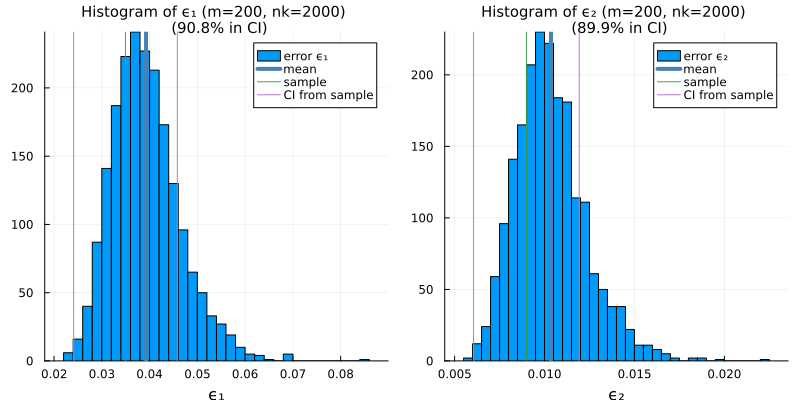
plot(size=(800, 400), allplts[2].hist1, allplts[2].hist2)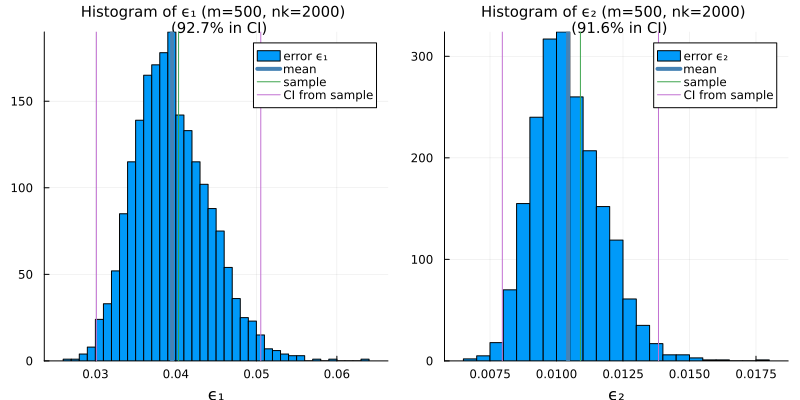
plot(size=(800, 400), allplts[3].hist1, allplts[3].hist2)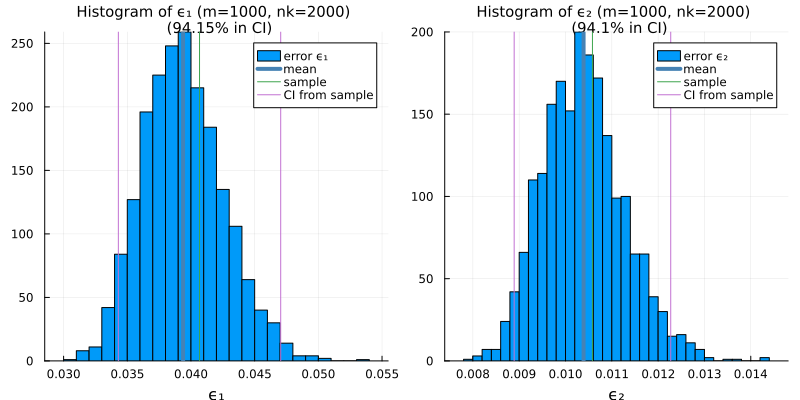
plot(size=(800, 400), allplts[4].hist1, allplts[4].hist2)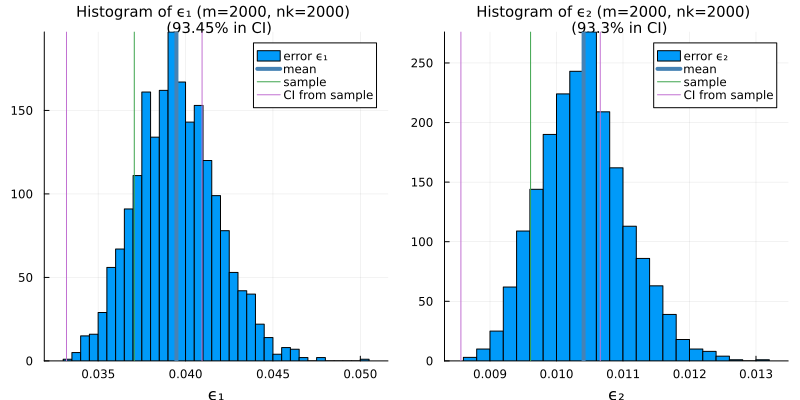
Density of the joint distribution of strong errors and their transformed distributions
In the following, we plot, on the left panel, the sample points of the joint distribution $(\epsilon_1, \epsilon_2).$ Because the way they were computed (using pathwise samples for the noise process in the finer mesh bridged from the one in the coarset mesh), this joint distribution is highly correlated (about 0.9 correlation, as calculated above). We can see this from the plots. We also plot a decorrelated sample obtained from shifting the indices of $\epsilon_2.$ Another option is to take the first half of $\epsilon_1$ and the second half of $\epsilon_2,$ to make them completely independent, but the result is about the same. We also illustrate one confidence region, from a single random sample, which is supposed to include the mean of the joint distribution, obtained by averaging the strong errors, which themselves are averagings of pathwise erros.
On the right panel, we see the corresponding transformed samples $(C, p) = (A^{\textrm{tr}}A)^{-1}A^{\textrm{tr}}(\epsilon_1, \epsilon_2)$ and transformed confidence region.
The confidence interval for the order of convergence $p$ is the projection, onto the $p$ axis, of the confidence region in the $(C, p)$ plane. It includes not only the samples within the confidence region but all of those in the band $p_{\min} \leq p \leq p_{\max},$ increasing considerably the confidence level.
plot(size=(800, 400), allplts[1].errors, allplts[1].cp)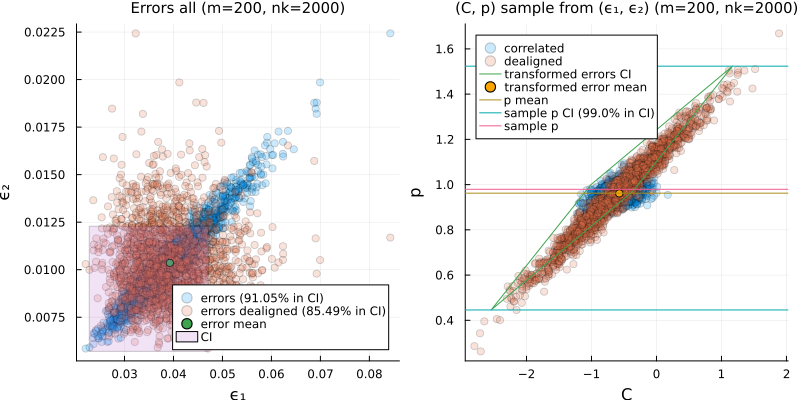
plot(size=(800, 400), allplts[2].errors, allplts[2].cp)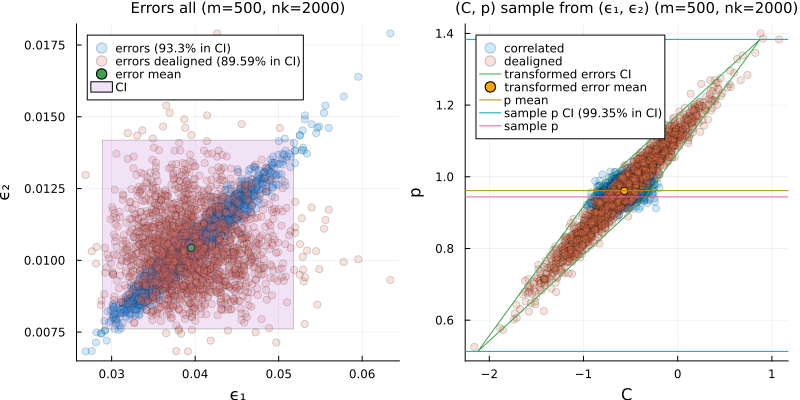
plot(size=(800, 400), allplts[3].errors, allplts[3].cp)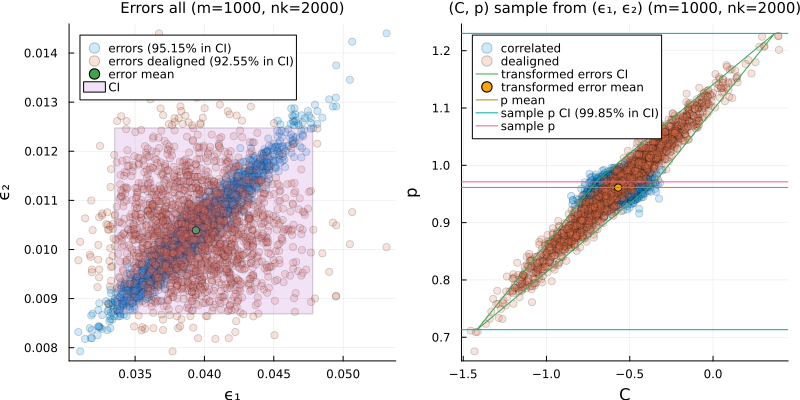
plot(size=(800, 400), allplts[4].errors, allplts[4].cp)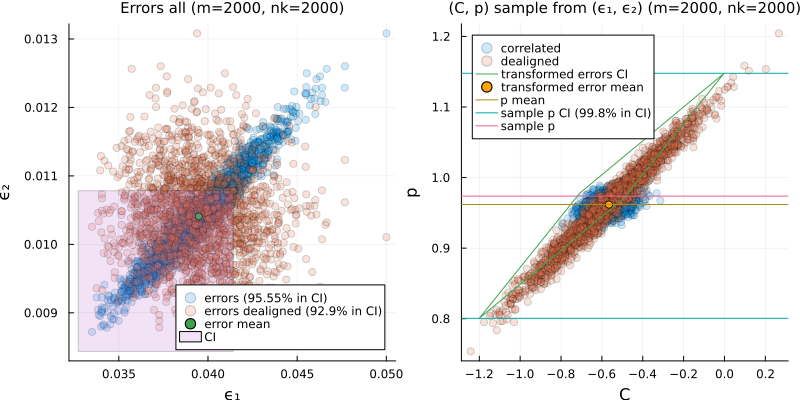
Histrogram of the order of convergence
Finally, we plot the histograms for $p$, obtained both from the correlated and the decorrelated strong errors. Notice that the distributions for $p$ resembles a normal distribution even for low samples, and building a CI from the decorrelated samples works fine, in this example, despite the fact that the theory does not guarantee that. But it works only with the uncorrelad samples! Nevertheless, it requires a lot more samples, being computationally quite expensive, especially with more complicate equations. The CI from the push-forward method underestimates the confidence level, but it is more trustworthy and less demanding.
plot(allplts[1].histp)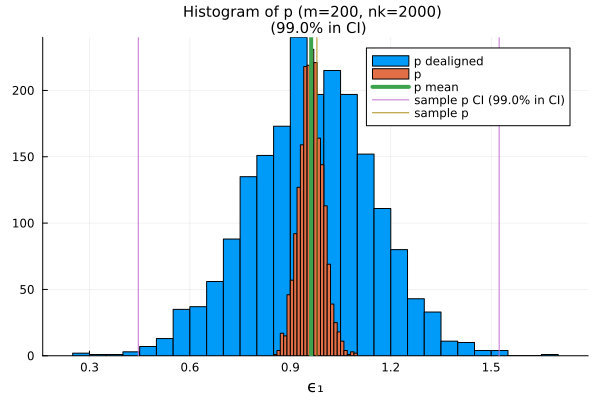
plot(allplts[2].histp)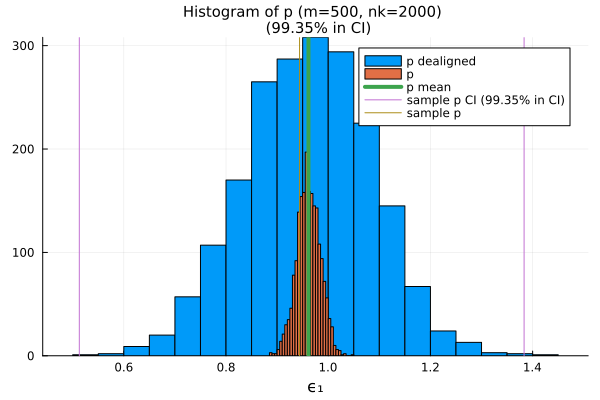
plot(allplts[3].histp)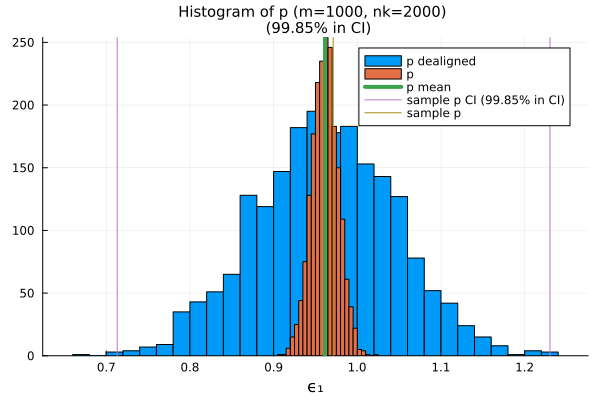
plot(allplts[4].histp)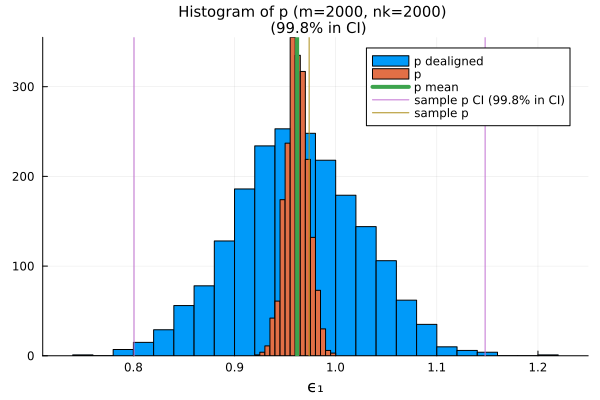
This page was generated using Literate.jl.